There is no denying that artificial intelligence now is integrated in various aspects of elections, particularly in campaigning as there is an increasing use of generative AI in producing campaign materials. While there have been beneficial impacts of using AI in campaigning, from generating materials to language translation helping extend the reach
Read the full issue here: "Resilience Watch | Monthly Brief on Countries Under Restrictive Environments (Series 03, Issue 03)" 🇧🇩 In Bangladesh, the political discourse was shaped primarily by disagreements over the implementation of the July National Charter and what this means for the country’s post-uprising institutional transition. The dispute over whether
In Bangladesh, two years after the July Uprising, Bangladesh's democratic transition has entered a decisive implementation phase. While the July National Charter continues to provide a shared framework for constitutional and institutional reform, political consensus on how those reforms should be implemented has begun to erode. Constitutional disagreements, the evolving role of
In June 2026, Bangladesh, Cambodia, Myanmar, and South Korea presented divergent but interlinked pictures of democratic governance under stress. In Bangladesh, the central democratic challenge during the post election period spread to be the growing gap between ambitious post-July reform commitments and their practical implementation. Nearly two years after the 2024 July
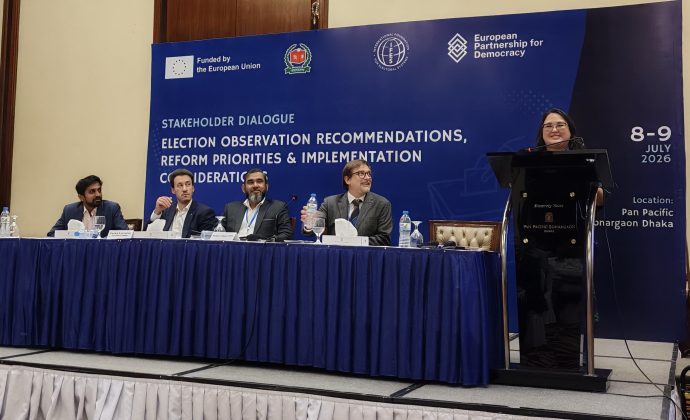
The Asian Network for Free Elections (ANFREL) participated in the "Stakeholder Dialogue on Election Observation Recommendations, Reform Priorities, and Implementation Considerations" in Dhaka, Bangladesh, 8-9 July 2026. The dialogue was jointly organized by the European Partnership for Democracy and International Foundation for Electoral Systems (IFES), in collaboration with the Bangladesh Election Commission
The Asian Network for Free Elections (ANFREL) has been monitoring electoral developments and the state of democracy in key areas in Asia where actions to push back against democratic backsliding have been noted. In the first quarter of 2026 alone, ANFREL deployed international election observation missions to elections in Thailand, Bangladesh, Nepal
Overview This issue of Data Dive is based on the findings and recommendations of ANFREL’s International Election Observation Mission for Bangladesh’s 2026 Parliamentary Elections and Referendum. In January 2026, ANFREL deployed an international election observation mission following over a year of engagement in strengthening citizen observer groups in Bangladesh, as well as
Final Report for the 2026 Bangladesh Parliamentary Election and Referendum Executive Summary The 2026 Bangladesh Parliamentary Elections and Referendum took place in a context shaped by the July 2024 youth-led uprising and amid heightened public scrutiny of state institutions. Against that backdrop, ANFREL observed an Election Day environment that was generally peaceful,
Executive Summary Bangladesh’s 2026 Parliamentary Elections and referendum took place in a transition context shaped by the July 2024 youth-led uprising and amidst heightened public scrutiny of state institutions. Against that backdrop, ANFREL observed an Election Day environment that was generally peaceful, orderly, and safe in the areas covered. This was a
12 February 2026 Dhaka, Bangladesh The Asian Network for Free Elections (ANFREL) commends the people of Bangladesh for their participation in the peaceful and orderly Parliamentary Elections and Referendum held on 12 February 2026. Nineteen months after the historic July Uprising, voters across Bangladesh arrived at polling stations with anticipation to cast
The Asian Network for Free Elections (ANFREL) deployed international election observers across Bangladesh to engage with various stakeholders and monitor election-related activities including preparations for the elections and campaign activities. They will also observe Election Day processes including voting and counting procedures. Bangladesh is set to hold the parliamentary elections and referendum
https://www.youtube.com/live/wNib_efvL7Q?si=vKrylQVW0YpRVrgt After the July 2024 uprising that toppled the regime of Prime Minister Sheikh Hasina and following pronouncements from the interim government that elections will be held, the election commission announced on 11 December 2025 that Bangladesh will hold elections on 12 February 2026. A total of 1,981 candidates are contesting 300
International election observers of the Asian Network for Free Elections (ANFREL) are ready for deployment after a two-day briefing in Dhaka, Bangladesh. In Day 2, the Bangladesh Election Commission briefed the observers on the electoral process while the Special Branch of Police provided a brief on election-related violence. ANFREL international election observers
The Asian Network for Free Elections (ANFREL) international election observers are in Dhaka, Bangladesh for a two-day briefing as part of the preparation for their deployment to observe the upcoming elections and referendum in the country. Day 1 (6 February 2026) covered core topics on the international election observation mission, the electoral
27 January 2026Dhaka, Bangladesh Today, the Asian Network for Free Elections (ANFREL) officially launched its International Election Observation Mission (IEOM) for the 13th Parliamentary Elections and Referendum in Bangladesh. The mission commenced today and will continue until 17 February 2026, spanning a period of 22 days. ANFREL will deploy 22 international election
The Asian Network for Free Elections (ANFREL) released today, 16 December 2025, the report of its pre-election assessment in Bangladesh for the 13th National Parliamentary Elections. The report assessed institutional preparedness, identify key risks to electoral integrity, and inform both national stakeholders and the design of future election observation missions. Read the
The Asian Network for Free Elections, in collaboration with the Bangladesh Election Commission, organized a one-day regional experience-sharing exchange on emerging electoral challenges and oversight, Dhaka, 23 November 2025. "Building Bridges: Regional Electoral Governance and Citizen Observation Exchange" gathered regional experts from election management bodies, civil society organizations, and election observer groups
In October 2025, ANFREL continued to observe significant political and electoral developments across Bangladesh, Cambodia, and Myanmar. In Bangladesh, ahead of the 13th National Elections scheduled for February 2026, twenty-two political parties endorsed the July National Charter 2025 on 17 October 2025, following an extensive process of dialogue facilitated by the National
The Asian Network for Free Elections (ANFREL) continued its coordination engagements with traditional election observation organizations and inclusion-rights groups in Bangladesh through a follow-up meeting held on 06 November 2025 in Dhaka. This round of discussions further strengthened communication, preparedness, and complementarity among citizen observer networks and organizations advocating for inclusion in
In September 2025, notable political and electoral developments took place across Bangladesh, Cambodia, and Myanmar. In Bangladesh, the National Consensus Commission continued to struggle to secure agreement among political parties on the July charter ahead of the upcoming elections, while the Election Commission pressed forward with its preparations. Along the Cambodia–Thailand border,
The Asian Network for Free Elections (ANFREL) convened the third round of its “Strengthening Citizen Election Observation in Bangladesh” engagements on 23 September 2025 in Dhaka. Building on the foundation-setting workshop in June 2025 and the specialized inclusion and election-day observation workshop in August 2025, this half-day meeting brought together traditional election
In August 2025, Bangladesh, Cambodia, and Myanmar witnessed significant political and electoral developments. The Election Commission intensified preparations for the upcoming general elections by introducing a new electoral roadmap. Meanwhile, in Myanmar, the military junta pushed forward with plans for its first election since the 2021 coup, introducing amendments to the electoral
https://www.youtube.com/live/WSdUsPecCu4?feature=shared In this episode of The Election Observer podcast, the Asian Network for Free Elections (ANFREL) discussed what preparations are being done for the next elections and the reforms that have been implemented to ensure electoral integrity in Bangladesh. Assistant Professor Md. Mostafa Hosain at the School of Law in Brac University,
All roads lead to the elections in Bangladesh. Interim government head of Bangladesh Muhammad Yunus announced on 5 August 2025 that he will write to the Election Commission chief requesting to hold elections before Ramadan in February 2026. In this episode of The Election Observer podcast, the Asian Network for Free Elections
The Asian Network for Free Elections (ANFREL) has wrapped up the second leg of its “Strengthening Citizen Election Observation in Bangladesh” workshops under the Bangladesh Elections and Democracy Programme. Held on 10–11 August 2025 in Dhaka, the sessions built on the momentum of the June 2025 workshop, diving deeper into inclusive election
In July 2025, Bangladesh, Cambodia, and Myanmar experienced a series of significant political and electoral developments, with notable election-related activity in Bangladesh and Myanmar. Bangladesh is preparing for its first national elections since the 2024 uprising, while Myanmar’s military junta is advancing plans for its first election since the 2021 coup. In
In June 2025, Bangladesh, Cambodia, and Myanmar witnessed a series of significant political and electoral developments. Bangladesh’s political landscape was marked by continued dialogue under the National Consensus Commission, with key debates over election timing, reform implementation, and party strategies. Tensions rose as Jamaat-e-Islami boycotted the second round’s opening session, while the
26 June, is the International Day in Support of Victims of Torture. Observed globally since 1988, the day signifies solidarity with victims of torture and cruel treatment around the world. On this day, Odhikar stands in solidarity with individuals subjected to oppression, torture, and all forms of cruel, inhuman, and violent acts
Citizen observers and civil society actors participated in a three-day workshop in Dhaka titled "Strengthening Citizen Election Observation in Bangladesh: Principles, Partnerships, and Framework Development." The workshop held from 19-21 June 2025 was organized to build stronger partnerships and shape a unified framework for citizen-led election observation in the country. The Asian
In May 2025, the political landscapes in Bangladesh, Cambodia, and Myanmar were marked by escalating tensions, deepening repression, and shrinking civic space. In Bangladesh, the struggle over national election time intensified with pressure on the Interim Government from both political parties and civil society. The chief advisor’s threat to resign underscored the